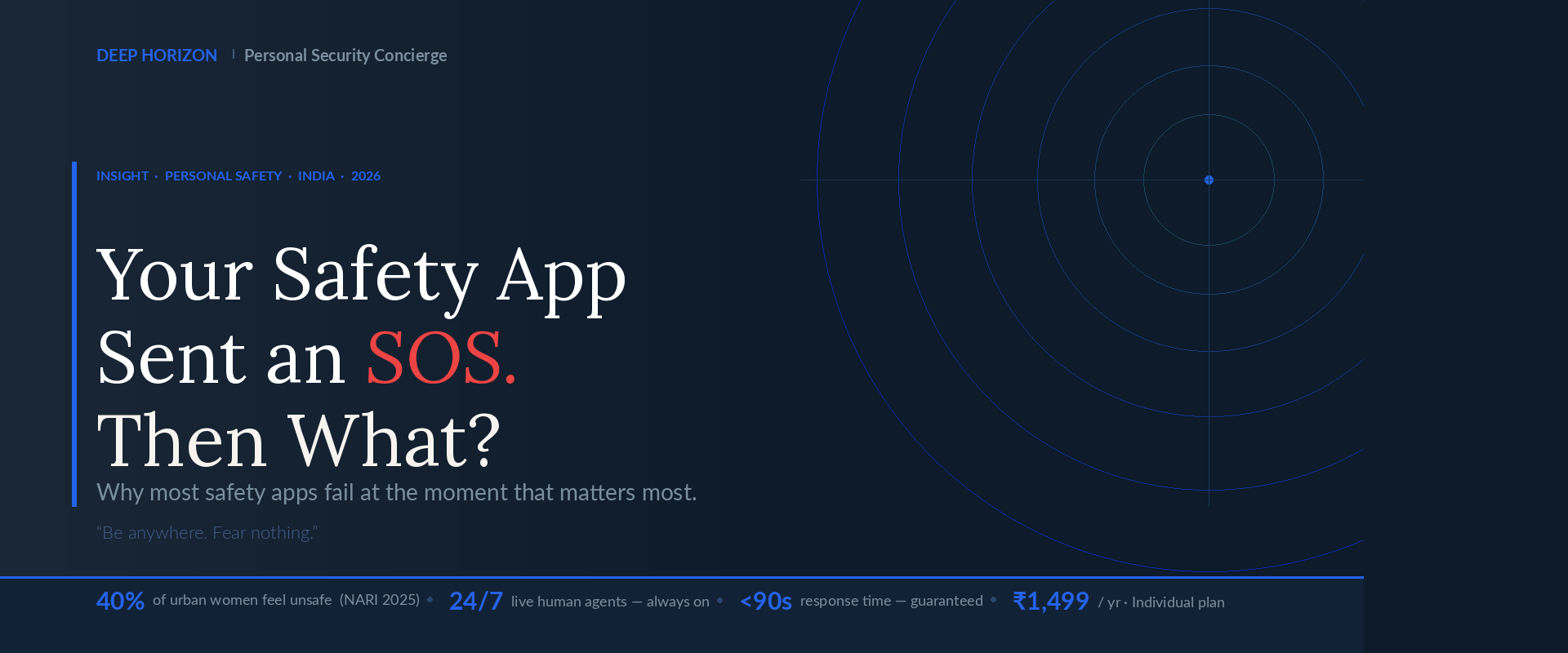
It is 11:47 pm. A 24-year-old woman is walking back to her paying guest accommodation after a late shift. Her route takes her through a stretch she has walked a hundred times before. Tonight, she takes a wrong turn. Her phone’s safety app detects the route deviation and triggers an SOS.
Her emergency contacts—her mother in another city and a college friend who is asleep—receive a push notification. Neither sees it for forty-three minutes.
This is how most safety apps in India work. They send a message. Then they wait.
The question nobody asks before downloading a safety app is the only question that actually matters: what happens in the minutes after an SOS is triggered?
According to the NARI 2025 report—India’s first comprehensive index on women’s safety—40% of urban Indian women reported feeling “not so safe” or “unsafe” in their own cities. Among women under 24, 14% reported experiencing harassment in public spaces in 2024 alone. Two-thirds of these incidents were never reported to authorities.
These are not numbers that a push notification can solve.
The Notification Problem: Why SOS Alone Is Not Enough
Every personal safety app available in India today shares a common architecture. A user presses a button or triggers an alert. The app sends a notification—via SMS, push alert, or WhatsApp message—to a pre-registered list of emergency contacts. Some apps share the user’s GPS coordinates. Some record audio. A few transmit video.
Then the app’s job is done.
The assumption behind this model is that the people receiving the notification will know what to do, will be awake, will be near their phone, and will be able to respond effectively. That is a significant assumption to stake someone’s safety on.
Consider the practical reality. An SOS alert arrives at 11:47 pm. The recipient is asleep, or in a meeting, or in a different city, or simply does not recognise the notification among dozens of others. Even if the recipient sees the alert immediately, what are they expected to do? Call the user? Call the police? Drive to the location? Most people, in most situations, do not have a clear protocol for responding to an emergency they did not witness.
The core issue is not the technology. The SOS transmission works. The issue is that a notification is not a response. It is the beginning of a process that most apps leave entirely to chance.
What Happens After an SOS on Deep Horizon
Deep Horizon is built on a fundamentally different premise: an emergency alert without a verified human response is incomplete.
When an SOS is triggered on Deep Horizon—whether manually by the user, or automatically through AI-powered route deviation detection—the alert does not simply travel to a contact list. It arrives at a staffed, 24/7 Security Operations Centre (SOC) where trained operators are on duty around the clock.
Here is what the response sequence looks like:
AI Detection and Alert 0–15 seconds
Deep Horizon’s AI layer continuously monitors for signals: manual SOS activation, route deviation from a planned path, missed safety check-ins, or voice pattern anomalies during verification calls. When a trigger is detected, the system escalates instantly.
Human Verification 15–90 seconds
A SOC operator receives the alert with full context: the user’s location, movement history, emergency contacts, and the nature of the trigger. The operator attempts to contact the user directly via an AI-verified call to distinguish between a genuine emergency and a false alarm.
Coordinated Response 90 seconds onward
If the user does not respond, or if the situation is confirmed as an emergency, the SOC operator executes a response protocol. This includes alerting the user’s emergency contacts with specific, actionable information—not just a notification, but a call explaining the situation—and, where applicable, coordinating with local emergency services.
The difference is not a feature. It is an entirely separate layer of infrastructure—a team of people whose only job is to be awake, alert, and trained to act when an emergency signal arrives.
Why a Human SOC Changes the Equation
The argument for a human-operated SOC is not philosophical. It is practical.
False alarms are inevitable in any safety system. A phone jostled in a bag can trigger an SOS. A route deviation might be a deliberate shortcut. An AI system that escalates every signal to the police without verification creates a different problem: alert fatigue. Emergency services that receive too many false alarms begin to deprioritise them.
Human verification solves this. A trained operator can distinguish between a pocket dial and a genuine distress signal in under sixty seconds. This means that when a real alert reaches emergency services or contacts, it carries weight. It has been confirmed by a person, not just flagged by an algorithm.
This is not a model that any competitor in India currently offers. Building and staffing a 24/7 SOC requires sustained investment in people, training, and operational infrastructure. It is not a feature that can be shipped in a software update. It is a commitment to a fundamentally different standard of safety.
The Gap Between “Safety App” and “Safety Infrastructure”
India has no shortage of safety apps. The Google Play Store lists hundreds. Most of them do the same thing: send a notification when a button is pressed.
What India does not have—until now—is personal safety infrastructure. Infrastructure means a system that works even when the user’s contacts are unavailable. It means response protocols that do not depend on the recipient knowing what to do. It means a layer of human accountability between an alert and an outcome.
Deep Horizon is designed to be that infrastructure. The AI layer provides speed and always-on monitoring. The SOC provides judgement and coordinated action. Together, they create a response system that does not end at the notification.
For the 40% of urban Indian women who reported feeling unsafe in the NARI 2025 study, the question is not whether a safety app exists. Hundreds do. The question is whether anyone is on the other end when they need it.
Deep Horizon’s answer is yes. Every hour. Every day.
If you believe that personal safety deserves more than a notification, Deep Horizon is available to download now. Plans start at ₹149/month for individuals and ₹649/month for families of up to five.
View Plans →Deep Horizon is India’s first AI-powered personal safety platform with a 24/7 human Security Operations Centre.