You have probably walked out of a late office, flagged down an auto near Paltan Bazaar at 10pm, and told yourself it would be fine. Most of the time, it is. But the moments when it is not—those are the moments nobody is prepared for.
Guwahati is one of the most dynamic cities in India right now. New colleges, expanding corporate offices, a growing PG ecosystem, and a generation of young women building independent lives here. The city is also navigating what every rapidly growing urban centre navigates: a lag between how fast people’s lives are changing and how fast safety infrastructure keeps up.
This guide is not about fear. It is about being prepared—because prepared people make better decisions in the moments that count.
What the Numbers Actually Say About Guwahati
Official crime data for Guwahati shows a general downward trend in registered crimes over recent years. But investigations into unregistered complaints tell a more complete story: a significant number of incidents—particularly harassment and petty crime—go unreported entirely.
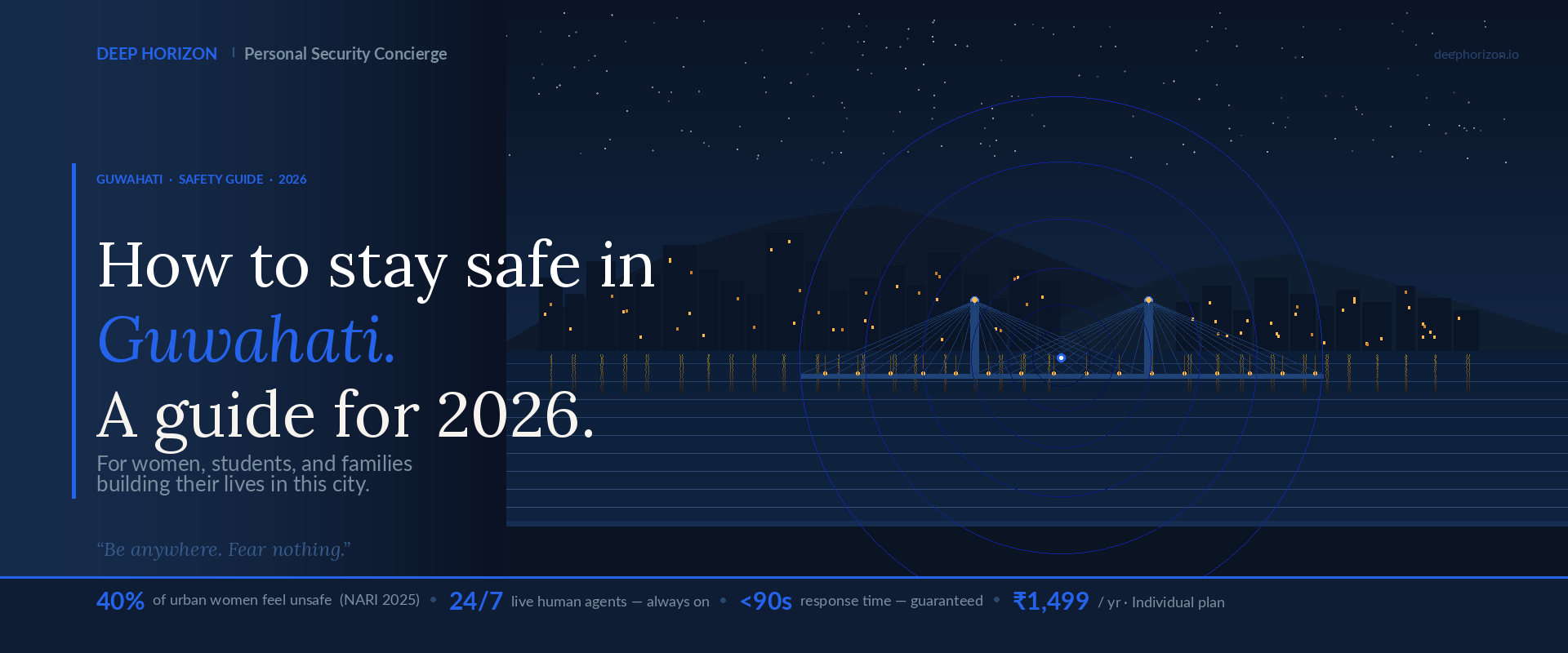
Nationally, the NARI 2025 report found that 40% of urban Indian women feel “not so safe” or “unsafe” in their own cities, and two-thirds of harassment incidents are never reported to police. Guwahati is not an outlier. It is a city where the official numbers and the lived experience of its women can look quite different.
Three specific patterns are worth knowing:
Cybercrime surge: Complaints in Guwahati surged from 131 in 2023 to 821 in 2024—a more than sixfold increase. Online fraud, fake emergency contacts, and phone-based scams are now part of the safety picture.
Transport hub risk: Incidents involving women travelling alone after 9pm are disproportionately concentrated around the railway station area in Paltan Bazaar and bus-stand routes, where foot traffic drops sharply after a certain hour.
Opportunistic crime: Chain snatching and opportunistic crimes have increased in certain commercial corridors, including Fancy Bazaar and GNB Road, particularly after dark.
None of this means Guwahati is uniquely dangerous. It means it requires the same informed awareness that any growing Indian city requires.
The Areas and Situations That Call for Extra Attention
Late-night transport hubs. Paltan Bazaar and its surroundings—which include the railway station and several private bus stands—are busy and well-lit during the day. After 9pm, the character of the area shifts. Women commuting alone through this zone late at night should have a clear plan: a confirmed ride, a trusted person tracking their route, and a check-in protocol.
Isolated stretches between well-known areas. The routes between Chandmari, Bhangagarh, and Dispur are dotted with quieter lanes that connect major roads. These stretches do not appear dangerous in daylight, but they are the kind of roads where a route deviation at midnight becomes genuinely concerning.
Public transport gaps. City bus service in Guwahati effectively stops before midnight. App-based cabs have improved coverage significantly, but availability after 11pm in non-central areas can still be inconsistent. The gap between the cab you booked and the one that arrives is where most anxiety sits.
Alone in a new PG. For the tens of thousands of students and young professionals new to Guwahati each year, the first few weeks involve navigating unfamiliar routes, building a contact network from scratch, and managing the uncertainty of not yet knowing which streets feel right at which hours.
What Smart Women in Guwahati Actually Do
The most effective personal safety practices are not dramatic. They are consistent.
Share your route before you move, not after. Before leaving for a late-night commute, send your live location to one person who you know is awake. Not a broadcast to five people—one person who will actually notice if you go quiet.
Use scheduled check-ins rather than open-ended tracking. Telling someone “I’ll message when I’m home” is a weak protocol—it depends entirely on you remembering. A scheduled check-in removes the dependency on memory.
Know your nearest police station. Guwahati Police publishes a complete list of station contacts. Save the number for the station closest to where you live. You may never need it, but those five seconds matter in an emergency.
Trust the instinct that something is off. The evidence on personal safety is consistent across cultures: people often sense a threat before they can articulate it. If something feels wrong on a route, change it. Do not debate yourself out of that instinct.
Plan for the phone-dies scenario. A depleted phone battery is the most common reason personal safety measures fail at the worst moment. A charging habit is a safety habit.
The Layer Most People Have Not Thought About
All of the advice above is good practice. But it shares a common limitation: it depends entirely on someone else being awake, available, and knowing what to do when you need them.
Your emergency contact at midnight in another city receives a notification. They see it when they wake up. They are not sure whether to call the police, call your landlord, or wait for another message from you. By the time they decide, forty minutes have passed.
This is the gap that Deep Horizon is designed to close—not replace the people in your life, but provide a professional layer that is always awake and always knows exactly what to do.
When you activate a scheduled check-in through Deep Horizon and miss it, a live human agent from our 24/7 Security Operations Centre attempts to reach you within 90 seconds. Not a notification. A person. Someone trained to assess the situation in real time, contact your emergency contacts with clear information, and coordinate with local services when needed.
For women new to Guwahati—students arriving from other cities, professionals in their first PG—this matters particularly. You may not yet have the local network that tells you which streets to trust. Deep Horizon’s SOC is operational from day one.
A City Worth Living In, Fully
Guwahati is a city worth being ambitious in. The opportunities here—academic, professional, personal—are real and growing. The goal of personal safety is not to shrink the city or restrict what you do in it. It is to build the layer of confidence that lets you move through it freely.
Most of the time, things are fine. But “most of the time” is not the same as “always”—and the one time that it is not fine deserves more than hope.
Be anywhere. Fear nothing.
Deep Horizon’s personal security concierge is available now in Guwahati. Scheduled check-ins, live Video Monitor with a human agent, route deviation alerts, and a 24/7 SOC that responds in under 90 seconds. Plans start at ₹1,499/year—less than ₹125/month.
View Plans →Deep Horizon is India’s personal security concierge—real-time monitoring, trained human backup, and silent emergency response. Ready the instant you need it. Built in Guwahati, designed for India.